
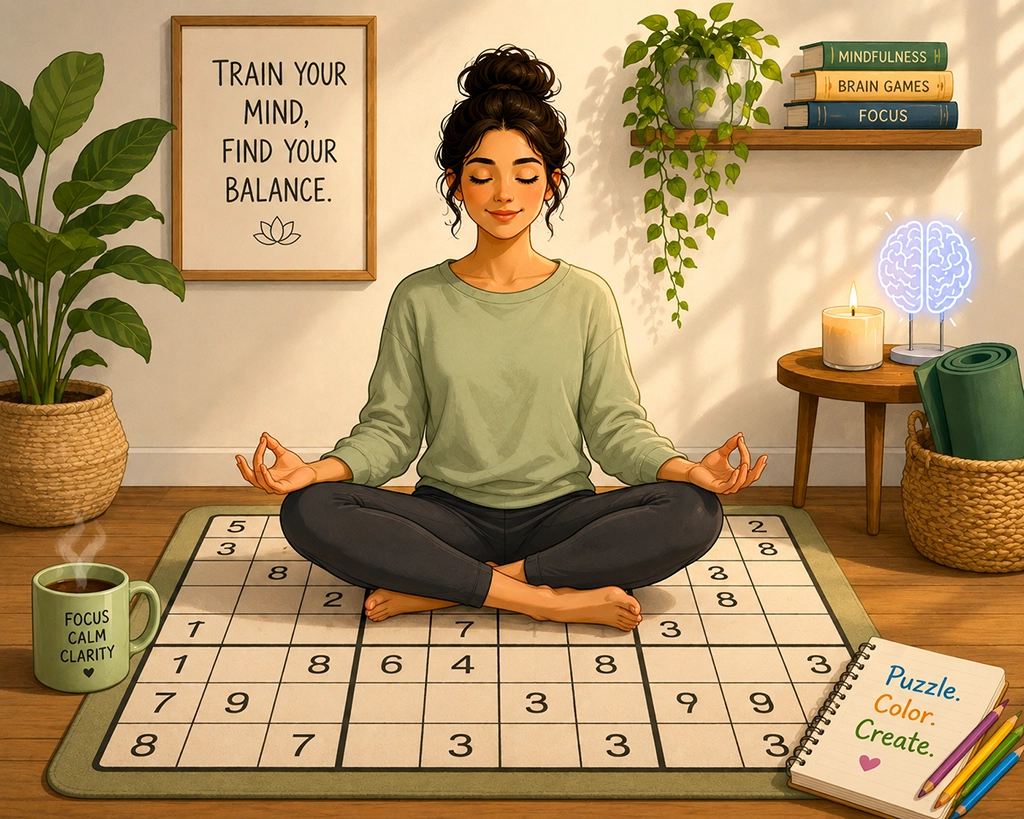
Brain games and meditation both promise a better mind. But they work in very different ways. Brain games give your brain a task to solve. Meditation trains you to slow down, focus and notice what is happening in the moment. This guide breaks down brain games vs meditation in a practical way so readers can decide what fits their goals, schedule and daily routine.
That makes the comparison interesting. If you want sharper thinking, should you grab a crossword, Sudoku puzzle or memory game? Or should you sit quietly and practice mindfulness for ten minutes?
The answer is not as simple as “one is better.” Research on meditation often looks at stress, anxiety, depression, pain and sleep quality, while brain game research tends to focus on memory, attention, processing speed and cognitive training results.
What Are Brain Games?
When I first started paying attention to brain games, I thought the term meant fancy apps with flashing buttons, timers and little progress charts that made me feel productive for about twelve minutes. Then I realized I had been doing brain games for years without calling them that. Sudoku, crossword puzzles, word searches, logic puzzles, memory games and even those little pattern puzzles in activity books all fit under the same general idea.
A brain game is any activity that gives your mind a clear task to work through. You might be finding hidden words, solving number patterns, remembering where matching cards are placed or using clues to fill in a crossword grid. The goal is usually simple, but the thinking behind it can be pretty useful.
My first mistake was thinking every brain game worked the same way. Nope. A word search does not train the same skills as Sudoku. A word search does not feel the same as a memory game. A logic puzzle hits different parts of your attention than a quick matching game on your phone.
That matters when comparing brain games vs meditation because brain games are active. You are doing something. You are looking, testing, solving, checking and sometimes muttering under your breath because you cannot believe you missed the word “banana” sitting diagonally across the page.
Sudoku is great for logical thinking, pattern recognition and working memory. You have to remember what numbers are already used, what numbers are possible and what choices can be ruled out. It feels quiet, but your brain is doing a lot.
Crossword puzzles lean more toward vocabulary, recall and clue solving. Word searches are easier for many people, but they still use visual scanning, focus and attention to detail. Logic puzzles can be the most intense because they force you to track relationships and make deductions step by step.
One thing I learned the hard way is that brain games should match your mood. If I am tired and I pick a hard logic puzzle, I usually get annoyed. That is not mental fitness. That is just me creating a tiny paper-based enemy.
For beginners, I like starting with low-pressure puzzle games. A simple word search, an easy Sudoku or a short memory game can be enough. You do not need a complicated brain training program to get mental stimulation.
The key is to treat brain games like practice, not proof that you are smart. Some days your focus is sharp. Some days it is soup. That does not mean the activity failed.
Brain games are best when they are fun enough to repeat. That is where the real value comes from. A puzzle you actually enjoy will do more for your daily routine than a “perfect” cognitive training game you quit after two days.
What Is Meditation?
Meditation used to sound way too serious to me. I pictured someone sitting perfectly still, breathing like a monk and having zero thoughts. Meanwhile, I would sit down for thirty seconds and remember that I needed paper towels, forgot to answer an email and should probably clean the junk drawer.
So yeah, my first few tries were not graceful.
The thing that helped me understand meditation was this simple idea: meditation is not about having no thoughts. It is about noticing your thoughts and coming back to your focus point. That focus point might be your breath, a sound, a guided meditation, a body scan or even a short phrase you repeat in your mind.
Once I learned that, meditation felt less like a test I was failing. It became more like attention training. My mind wandered, I noticed it, then I came back. Over and over. Not glamorous, but useful.
Mindfulness meditation is probably the type most people hear about first. It usually means paying attention to the present moment without judging every thought that pops up. Breath awareness is even simpler. You focus on breathing in and breathing out.
Guided meditation can be helpful for beginners because someone talks you through the process. That was easier for me at first because silence made my brain act like a browser with 47 tabs open. A calm voice gave me something to follow.
Body scan meditation is another good one. You slowly notice different parts of your body, from your feet to your head. It can help when stress shows up as tight shoulders, jaw tension or that weird clenched feeling you do not notice until the day is almost over.
When comparing meditation to brain games, the biggest difference is the pace. Brain games ask you to solve. Meditation asks you to notice. One gives your mind a job. The other teaches your mind how to settle down and return to the present.
That does not mean meditation is always relaxing right away. Sometimes it is frustrating. Sometimes sitting quietly makes you more aware of how busy your thoughts are. That was a surprise for me.
But that awareness can be the point. You start seeing how often your mind jumps ahead, replays conversations or turns tiny problems into big productions. Been there.
For stress relief, meditation can be a strong tool because it gives you a pause. Even five minutes can create a little space between what happens and how you react. That is not magic. It is practice.
If someone is brand new to meditation, I would not suggest starting with thirty minutes. Start with two minutes. Seriously. Sit down, breathe, notice when your mind wanders and come back.
A short meditation routine is easier to repeat, and repetition is where the benefit starts to show up. Not all at once. Not perfectly. But over time, it can help with focus, emotional regulation and mental clarity.
Brain Games vs Meditation: The Main Difference
The main difference between brain games vs meditation is that brain games challenge your thinking, while meditation trains your attention and awareness. That sounds simple, but it changes how each one feels in real life.
With brain games, there is usually a goal. Finish the crossword. Find all the words. Solve the Sudoku. Complete the maze. You know when you are done, and that tiny feeling of completion can be really satisfying.
Meditation does not usually give you that same “finished the puzzle” feeling. You do not win meditation. There is no gold star because you breathed correctly for five minutes. Annoying, honestly, but also kind of important.
I used to judge meditation like I judged puzzles. If my mind wandered, I thought I had messed it up. Then I learned that noticing the wandering is part of the practice. That changed everything.
Brain games are active mental challenges. They use problem solving, memory, focus, pattern recognition and sometimes language skills. Meditation is more about returning your attention, calming your body and noticing what is happening inside your mind.
Think of it this way. A word search asks your brain to scan and find. A Sudoku puzzle asks your brain to test and reason. A meditation session asks your brain to pause, notice and return.
Neither one is better in every situation. That is where a lot of people get tripped up. They want one answer. Brain games vs meditation. Pick a side.
I do not think that is the best way to look at it.
If I want mental stimulation, I reach for a puzzle. If I want to calm down after a stressful day, I usually start with breathing or a short guided meditation. If I am restless but not upset, a puzzle works better because I still want something to do.
Brain games can be especially helpful for people who dislike sitting still. Meditation can feel like too much nothing at first. A puzzle gives the mind a place to go, which can make relaxation easier.
Meditation can be better when your brain feels overloaded. If you are already stressed, a hard puzzle might not help. It might just become one more thing you cannot solve, which is not exactly peaceful.
The trick is knowing what you need in the moment. Do you need a challenge or a reset? Do you want to think harder or slow down? Do you want a screen-free activity or a quiet breathing break?
When people ask me about brain games vs meditation, I usually say this: brain games are like giving your brain a workout, while meditation is like teaching your brain how to recover. Both matter.
And just like exercise, you do not need to go extreme. Ten minutes of puzzles and five minutes of meditation can be enough to build a daily habit that feels useful instead of overwhelming.
Benefits of Brain Games for Mental Sharpness
The thing I like about brain games is that they make mental sharpness feel practical. You do not have to sit around wondering if your brain is being “trained.” You are right there solving something, checking clues and making decisions.
That hands-on feeling matters. When I do a Sudoku puzzle, I can feel myself slowing down and paying closer attention. I have to stop guessing, because guessing in Sudoku usually turns into a mess fast.
Brain games can help practice focus because they reward attention. In a word search, you have to scan carefully. In a crossword puzzle, you have to connect clues to words you already know. In a logic puzzle, you have to hold several pieces of information in your head without losing track.
The first benefit is concentration. A puzzle gives you one clear task. That sounds basic, but in a world where every screen is begging for attention, one clear task is kind of a big deal.
Another benefit is problem solving. Brain games make you test ideas. You try one path, notice it does not work, then adjust. That is a useful habit beyond puzzles too.
Working memory also gets involved, especially with Sudoku, memory games and logic puzzles. You have to remember what has already been used, what is still possible and what clues connect to each other. It can be tiring, but in a good way.
Word games can support vocabulary and recall. Crossword clues make you dig around in your memory for names, phrases, definitions and wordplay. Sometimes the answer is right there in your brain, but it takes a minute to pull it out.
Visual scanning is another skill that gets practiced with word searches, mazes and hidden object games. You learn to look closely. You stop rushing. That was something I had to work on because I tend to skim and then act surprised when I miss obvious things.
For mental sharpness, I think the best brain games are the ones that are challenging but not miserable. If a puzzle is too easy, you might zone out. If it is too hard, you might quit. The sweet spot is a puzzle that makes you think but still feels possible.
I like using a simple difficulty ladder. Start with easy puzzles to warm up, move to medium puzzles for focus and save hard puzzles for days when your brain has some gas in the tank. That little system saves a lot of frustration.
Brain games are also great for screen-free mental stimulation. A printable puzzle, a puzzle book or a simple notebook of word games can give your brain something to do without more scrolling. That is underrated.
The honest limit is that getting better at one brain game usually means you are getting better at that type of brain game. A crossword habit may help with word recall, but it will not automatically make you a genius at math. Sad but fair.
Still, brain games can be a smart part of a mental fitness routine. They are affordable, repeatable and easy to fit into small pockets of time. Ten minutes counts.
Benefits of Meditation for Stress and Focus
Meditation helps me most when my brain feels crowded. Not broken. Just crowded. Like too many thoughts are trying to squeeze through the same doorway at once.
That is where meditation is different from brain games. A puzzle gives the mind something to solve. Meditation gives the mind a chance to stop grabbing every thought that walks by.
For stress relief, that pause can be powerful. When I first tried short breathing exercises, I expected to feel calm right away. I did not. I mostly felt impatient and wondered how long five minutes could possibly last.
But after sticking with it for a while, I noticed something useful. I could catch stress a little earlier. Instead of realizing at night that I had been tense all day, I started noticing it during the day.
That is one of the biggest benefits of meditation. It builds awareness. You start to notice shallow breathing, tight shoulders, racing thoughts and that little inner voice that turns small problems into full productions.
Mindfulness meditation can also help with focus because the whole practice is based on returning your attention. You focus on your breath. Your mind wanders. You bring it back. Then it wanders again because of course it does.
That repeated return is the training. It is not flashy, but it works like practice. You are teaching your attention how to come back without making a big dramatic scene about it.
For beginners, I like very short sessions. Two to five minutes is enough to start. A lot of people try twenty minutes on day one, hate it and then decide meditation is not for them.
Breath awareness is the easiest place to begin. Sit comfortably, breathe normally and notice the feeling of the air moving in and out. When your mind wanders, say “thinking” in your head and return to the breath.
Guided meditation is helpful if silence feels awkward. There are plenty of beginner-friendly options where someone walks you through the practice. A body scan can also work well before bed because it brings attention out of your racing thoughts and into your body.
Meditation can support emotional regulation too. That does not mean you become calm all the time. Please. Nobody needs that fake robot version of peace.
It means you may get a little better at pausing before reacting. You may notice irritation before you snap. You may catch worry before it turns into an hour of mental spinning.
The practical tip I wish I learned sooner is to connect meditation to something you already do. After coffee. Before opening your laptop. After brushing your teeth. Before bed.
A meditation routine does not have to look impressive. It just has to be repeatable.
For stress and focus, meditation is not about escaping your thoughts. It is about seeing them clearly enough that they stop running the whole show. That is a quiet win, but it is a real one.
Which Is Better for Focus?
If the goal is focus, brain games and meditation both help, but they help in different ways. Brain games train focus through challenge. Meditation trains focus through attention control.
That difference matters.
When I want active focus, I use a puzzle. Sudoku is one of my favorite examples because it forces me to stay with the grid. If I rush, I make mistakes. If I slow down, the pattern starts to open up.
A word search is different, but it still builds focus. You have to scan rows, columns and diagonals without giving up after thirty seconds. It is a lighter kind of attention, which can be perfect when your brain is not ready for something heavy.
Crosswords are great when you want language-based focus. You read a clue, search your memory and test the answer against the crossing words. There is a nice back-and-forth rhythm to it.
Meditation is better for a different kind of focus. It helps when your attention feels jumpy. You sit, breathe and practice coming back every time your mind runs off.
The funny part is that meditation can feel like you are doing nothing, but your attention is actually working hard. It is just not solving a puzzle. It is learning how to stay.
I used to think focus meant forcing myself to concentrate harder. That usually made me tense. Meditation taught me that focus can also mean relaxing enough to return to one thing again and again.
So which one is better? It depends on the problem.
If you are bored and need mental stimulation, brain games are probably better. A crossword, Sudoku puzzle or logic puzzle gives your mind a clear target. That can help you get into a focused state faster.
If you feel scattered, anxious or overstimulated, meditation may be better. A puzzle might add more noise when what you really need is a reset. This was a lesson learned after trying to do a hard puzzle while already stressed. Bad idea. Very bad.
Here is a simple way to choose. If your mind feels sleepy, choose a brain game. If your mind feels loud, choose meditation.
For a daily focus routine, combining both works well. Try five minutes of meditation, then ten minutes of puzzles. The meditation helps settle your attention, and the puzzle gives that attention somewhere useful to go.
You can also flip it. Do a quick word search first if sitting still feels impossible, then try two minutes of breathing after. Sometimes the puzzle gets the restlessness out of the way.
For featured snippet purposes, the answer is this: brain games are better for active concentration and mental challenge, while meditation is better for calming scattered attention. For best results, use both based on your mood and goal.
That answer feels boringly balanced, but it is true. And honestly, balanced usually works better than pretending one habit fixes everything.
Which Is Better for Stress Relief?
For stress relief, meditation usually has the edge. That does not mean brain games cannot be relaxing. They absolutely can. But meditation is more directly built around calming the mind and body.
I learned this after trying to use hard puzzles as stress relief. I would be tired, cranky and already mentally fried, then I would open a difficult Sudoku puzzle like that was going to save me. Five minutes later, I was annoyed at a number grid. Not my finest work.
The problem was not the puzzle. The problem was timing. I picked a challenge when I needed calm.
Meditation works well for stress because it slows the pace. Breathing exercises, mindfulness meditation and body scan meditation all ask you to notice what is happening right now. That can pull you out of the mental loop of replaying, planning and worrying.
A simple breathing practice can be enough. Breathe in for four counts, breathe out for six counts and repeat for a few minutes. Longer exhales can feel calming for many people because they encourage the body to slow down.
Guided meditation can also help when stress is high. I like it because you do not have to figure out what to do. You just follow the voice, breathe and let the next instruction be given to you.
Brain games can still help with stress relief, but the type of puzzle matters. Easy word searches, gentle crossword puzzles, coloring-style puzzles and simple mazes can give your mind a break from worry. They work because they shift attention to a clear, low-pressure task.
That is different from meditation, but still useful. Sometimes stress needs quiet. Sometimes stress needs a safe distraction. A puzzle can be that.
The trick is to avoid turning a relaxing puzzle into a performance. You do not need to finish it fast. You do not need to prove anything. You can just do the puzzle for ten minutes and stop.
I also think printable puzzles are great for stress relief because they get you away from screens. Phones can be helpful, sure, but they also come with notifications, news, messages and a thousand tiny interruptions. A paper puzzle just sits there. Beautifully boring.
When I feel tense, I use a simple rule. If I feel overwhelmed, I start with meditation. If I feel restless, I start with a puzzle. If I feel both, I do two minutes of breathing and then an easy word search.
That mix works because stress does not always show up the same way. Some stress feels heavy. Some stress feels jumpy. Some stress feels like you need to do something with your hands before you can settle down.
So the practical answer is this: meditation is usually better for stress relief, especially when your mind feels overloaded. Brain games can help when they are enjoyable, easy enough and used as a calming activity instead of another challenge.
And please, do not pick the hardest logic puzzle in the book when you are already having a rough day. I have done it. It was not healing. It was just spicy frustration.
Which Is Better for Brain Health?
Brain health is one of those phrases that sounds simple until you try to define it. Are we talking memory? Focus? Stress? Mood? Sleep? Problem solving? All of it gets tossed into the same bucket, which can make the brain games vs meditation question a little messy.
I like to think of brain health as a set of habits, not one magic activity. Brain games can support mental stimulation. Meditation can support stress management and attention. But neither one should be treated like a guaranteed shield against every memory problem or health concern.
That is an important point because brain games sometimes get oversold. I love puzzles, but I do not like when they are presented as a miracle fix. A Sudoku puzzle is great. It is not a medical plan.
Brain games can be helpful because they give your mind regular practice. You use working memory, visual scanning, language skills, logic and pattern recognition. Those are real thinking skills, and using them can be valuable.
Meditation supports brain health from another angle. Stress can affect how we feel, think and focus. A mindfulness routine may help people manage stress better, which can make daily thinking feel clearer.
The most helpful routine is usually not brain games or meditation by itself. It is brain games, meditation, physical activity, sleep, social connection, learning and decent food. I know that list sounds basic, but basic habits are usually where people get the most mileage.
I made the mistake of looking for the one “best” brain habit. That led to a lot of overthinking. Should I do puzzles? Should I meditate? Should I learn a language? Should I walk more?
The answer was yes, but not all at once.
A realistic brain health routine might look like this: ten minutes of puzzles three days a week, five minutes of meditation most days, a walk when possible and a regular sleep schedule. Not fancy. Very doable.
For older adults, brain games can be especially appealing because they are familiar and easy to access. Crossword puzzles, word searches and Sudoku are low-cost and can be done at home. Meditation can also be adapted for different ages and ability levels, especially with guided audio.
The key is enjoyment. If someone hates meditation, forcing it for thirty minutes a day probably will not last. If someone hates number puzzles, Sudoku is not the best entry point. Choose the habit that feels repeatable.
For brain health, consistency matters more than intensity. A short daily habit beats a huge plan that falls apart by Thursday. I have tested this. Thursday wins more often than we admit.
The best answer is balanced. Brain games are better for active mental stimulation. Meditation is better for stress management and attention awareness. Together, they can be part of a healthy brain routine.
Just keep the claims honest. Use puzzles because they challenge the mind. Use meditation because it helps train calm attention. Use both because life is easier when your habits are simple enough to actually do.
Brain Games vs Meditation for Different Goals
The easiest way to compare brain games vs meditation is to stop asking which one is “better” and start asking what you need today. That little shift makes the decision much easier.
If your goal is quick mental challenge, brain games win. A five-minute word search, one Sudoku grid or a short logic puzzle gives your mind something clear to do. You start, solve and finish.
If your goal is calming the mind, meditation usually wins. A short breathing exercise or guided meditation can help you slow down. You are not trying to solve anything, which is exactly the point.
If your goal is stress relief, I would usually start with meditation. Not always, but usually. When the mind is overloaded, adding a hard puzzle can feel like adding another tab to an already frozen computer.
If your goal is screen-free relaxation, both can work. A printable puzzle is great because it keeps your hands busy and your eyes off a screen. Meditation is great because it asks for almost nothing, except a few quiet minutes.
If your goal is improving focus, choose based on the type of focus you want. Brain games are better for task-based focus. Meditation is better for attention control when your thoughts keep wandering.
If your goal is family time or group activity, brain games are the clear winner. You can solve crosswords together, race through word searches or work on a puzzle page at the table. Meditation can be shared too, but it is usually more personal and quiet.
If your goal is emotional regulation, meditation gets the nod. It teaches you to notice thoughts and feelings without reacting right away. That pause can be really useful in everyday life.
If your goal is mental stimulation for older adults, brain games are a strong option. Crossword puzzles, memory games and Sudoku are easy to understand and easy to repeat. Meditation can also be helpful, especially for relaxation and stress support.
If your goal is building a habit, the winner is the one you will actually do. This is where people overcomplicate things. The best routine is not the perfect one. It is the one that survives real life.
I once tried a routine that had meditation, journaling, reading, stretching and a puzzle every morning. It looked amazing on paper. It lasted maybe three days.
A better routine was much smaller. Five minutes of breathing or one puzzle page. That was it. Because it was simple, it was easier to repeat.
For people who dislike sitting still, start with brain games. A puzzle can ease the mind into focus without asking you to be quiet right away. After that, try one or two minutes of breathing.
For people who feel mentally drained, start with meditation. Let the mind settle before asking it to solve something. Then choose an easy puzzle if you still want a little mental activity.
So the goal-based answer is simple. Use brain games when you want challenge, play and mental stimulation. Use meditation when you want calm, awareness and stress relief. Use both when you want a routine that supports focus from more than one angle.
How to Combine Brain Games and Meditation
Combining brain games and meditation works better than I expected. At first, I thought they were totally separate habits. One was quiet and mindful. The other involved me arguing with a Sudoku grid like it owed me money.
But they actually pair well.
Meditation can help settle your attention before a puzzle. Brain games can give your attention something useful to do after meditation. Together, they create a routine that feels both calm and active.
The simplest version is a 15-minute routine. Do five minutes of breathing, then ten minutes of puzzles. That is enough time to feel useful without turning it into a whole production.
For the meditation part, keep it basic. Sit comfortably, breathe normally and notice the breath. When your mind wanders, bring it back. No need for candles, special music or perfect posture unless those things help you.
For the puzzle part, choose something that matches your energy. If you feel sharp, try Sudoku or a logic puzzle. If you feel tired, try a word search, maze or easy crossword.
A morning routine might look like this: three minutes of breathing, then one small puzzle. This can help you start the day with focus instead of jumping straight into screens. I like this because it gives your brain a warm-up without making the morning feel crowded.
An evening routine can be softer. Try an easy word search or coloring-style puzzle first, then a short body scan meditation before bed. The puzzle gives your mind a gentle task, and the meditation helps you wind down.
You can also use a weekly rhythm. Brain games three to five days per week. Meditation three to seven days per week. That sounds flexible because it should be flexible.
The mistake I made was trying to do everything every day. That turned a helpful habit into homework. And once something feels like homework, it starts slipping.
A better approach is to build a menu. Some days you choose a puzzle. Some days you choose meditation. Some days you do both.
For example, Monday could be Sudoku and five minutes of breathing. Tuesday could be a guided meditation only. Wednesday could be a word search. Thursday could be a logic puzzle and a short breathing break.
Tracking can help too, but keep it simple. Write down what you did and how you felt after. Use words like calm, focused, frustrated, sleepy or energized.
After a week, patterns show up. You might notice that hard puzzles are better in the morning. You might notice that meditation works better before bed. You might notice that word searches are your favorite stress relief activity, which is useful information.
The best combined routine is not the most impressive one. It is the one you repeat because it feels good enough and easy enough.
For GoodStuffGames style content, this is also a natural place to mention printable puzzles. A reader can pair a free word search, Sudoku puzzle or maze with a short mindfulness break. That makes the advice practical right away.
Brain games and meditation do not need to compete. Use meditation to steady the mind. Use brain games to challenge it. That combo is simple, low-cost and easy to personalize.
Common Mistakes to Avoid
The biggest mistake with brain games vs meditation is expecting too much too fast. I have done this with both. I tried one meditation session and wondered why my mind was not suddenly calm and wise. Then I did a few puzzles and acted like I should feel mentally upgraded by Friday.
That is not how habits work.
With brain games, one common mistake is treating them like a guaranteed brain health solution. Puzzles are helpful for mental stimulation, but they are not magic. They should be part of a healthy routine, not the whole routine.
Another mistake is choosing puzzles that are too hard for your current mood. Hard puzzles are great when you want a challenge. They are not always great when you are tired, stressed or already frustrated.
I learned to keep easy puzzles around for low-energy days. Easy word searches, simple mazes and beginner Sudoku puzzles can still be relaxing. Not every puzzle needs to be a battle.
With meditation, a common mistake is thinking you are supposed to stop all thoughts. That one trips up almost everyone. Your mind will wander. That is normal.
The practice is noticing the wandering and coming back. If you do that fifty times in five minutes, you did not fail. You practiced fifty times.
Another mistake is starting too big. A thirty-minute meditation session sounds great, but it can feel endless for a beginner. Two minutes is a better starting point for most people.
People also turn meditation into another task to feel guilty about. That defeats the purpose. If you miss a day, just start again the next day.
With both habits, consistency matters more than intensity. Ten minutes of puzzles a few times a week is better than a giant brain training plan you abandon. Five minutes of meditation is better than waiting for the perfect quiet morning that never comes.
Another mistake is using either habit to avoid bigger problems. If stress is serious, meditation can help, but it may not be enough by itself. If memory concerns are affecting daily life, brain games are not a substitute for professional advice.
It is also easy to forget enjoyment. If you hate the activity, you probably will not keep doing it. Choose a brain game you like. Choose a meditation style that feels manageable.
Do not compare your routine to someone else’s. Some people love silent meditation. Some people need guided audio. Some people love hard Sudoku. Some people want cozy word searches with a cup of coffee.
All of that is fine.
The goal is not to build the perfect routine. The goal is to build a useful one. A routine that fits your brain, your schedule and your actual life will beat the “ideal” plan every time.
Final Verdict: Should You Choose Brain Games or Meditation?
The final verdict on brain games vs meditation is this: choose brain games when you want active mental challenge, and choose meditation when you want calm, focus and stress relief. If you want a stronger daily routine, use both.
That is not the most dramatic answer, but it is the most useful one.
Brain games are great when you want to think, solve and engage your mind. Sudoku, crossword puzzles, word searches, logic puzzles and memory games all give your brain a specific task. That can be satisfying, especially when you want a break that still feels productive.
Meditation is better when your mind feels scattered or overloaded. It gives you a way to pause, breathe and notice what is happening. You are not trying to win anything. You are practicing awareness.
I used to want one habit to be the winner. It would have been easier that way. Just tell me the best thing and I will do that.
But real life does not work like that. Some days I need a puzzle because I want a mental workout. Some days I need meditation because my thoughts are doing laps.
The best choice depends on the moment. If you are bored, try a brain game. If you are stressed, try meditation. If you are restless, try a light puzzle before a short breathing session.
For focus, both can help. Brain games build focus through problem solving. Meditation builds focus through returning attention. Those are different skills, and both are useful.
For stress relief, meditation usually has the stronger advantage. But relaxing puzzles can help too, especially when they are easy, familiar and enjoyable. A cozy word search can be a nice mental reset.
For brain health, neither habit should stand alone. Add movement, sleep, social connection, learning and breaks from screens. It does not have to be complicated, but it should be balanced.
My favorite recommendation is a 7-day experiment. For one week, try five minutes of meditation on some days and ten minutes of brain games on others. On one or two days, combine them.
At the end of each day, write down how you felt. More focused? Less tense? Frustrated? Calm? Energized? That tiny bit of tracking gives you better answers than guessing.
The winner is the habit you will repeat. That might be meditation. It might be puzzles. It might be a mix of both.
And honestly, that is good news. You do not have to choose one forever. You can build a simple routine that gives your brain challenge when it needs challenge and quiet when it needs quiet.
When comparing brain games vs meditation, the better choice depends on what you want from the moment.
Need a mental workout? Try a puzzle. Need to settle your mind? Try meditation. Want a routine that feels useful and easy to repeat? Use both.
A simple mix of brain games, meditation, movement, sleep and creative downtime can give your day more structure without making it complicated. Start small. Pick one puzzle. Take five quiet breaths. Then notice what helps you feel more focused, calm and ready for the next part of your day.