

Can a simple puzzle really help keep your mind sharp? I think a lot of people underestimate how useful word searches can be. They look simple at first glance, but once you start scanning letters, spotting patterns and staying focused on the task, you realize they ask more from your brain than expected. That is part of what makes word search for mental agility such a strong topic.
For many adults, mental agility is not about doing something extreme. It is about giving the brain regular practice with attention, visual scanning, memory and concentration. Word searches offer an easy way to do that. They are accessible, low pressure and flexible enough to fit into a daily routine. Whether you enjoy puzzles for relaxation, brain exercise or both, word searches can play a useful role in keeping your mind active.
What Does Mental Agility Mean?
Mental agility is your ability to think clearly, shift attention and respond to new information without getting stuck. It includes focus, visual scanning, working memory and mental flexibility. You use it when you follow directions, spot mistakes, switch tasks or solve a problem under time pressure.
A lot of people hear the phrase and think it means speed alone. It does not. Speed matters, but control matters too. You want to notice details, hold information in mind and make decisions without losing track of what you are doing.

That is why simple puzzles can help. They give your brain a small task with clear rules. In a word search, you look for target words in a grid of letters. To do that well, you need to stay focused, scan in an organized way and ignore wrong matches. Those are all parts of mental agility.
Mental agility also shows up in daily life. You use it when you read a crowded menu and find what you want fast. You also use it when you compare two similar emails and catch the one difference that matters. And you use it when you move from one task to another and keep your place.
Word searches do not test every mental skill. They will not replace sleep, movement or learning new things. Still, they can give you regular practice in a few useful areas. That makes them a practical option for people who want a low-pressure way to stay mentally engaged.
The main value is not that the puzzle feels impressive. The value is that it asks you to pay attention. It asks you to keep looking. It asks you to sort through noise and find a pattern. That kind of practice can make a basic puzzle feel more useful than it first appears.
How Word Search Puzzles Challenge the Brain
Word searches look easy until you sit down with a harder one. Then you notice how much attention they actually require. You are not just reading. You are scanning, checking letter patterns and testing possible matches in several directions.
The first challenge is visual search. Your eyes move across rows, columns and diagonals looking for a starting letter. Once you find one, you check the letters around it to see if they match a target word. That takes control. If you rush, you miss things. If you scan without a plan, you waste time.
The second challenge is attention control. The grid is full of distractions. Many letters look like they might form a word, but most do not. Your brain has to ignore false starts and keep working through the list. That process trains selective attention. You focus on what matters and block out what does not.
The third challenge is pattern recognition. Frequent puzzle solvers start to notice common letter groupings faster. They spot endings like ING or TION. Or they notice repeated starting letters. They get better at scanning for shape and structure instead of checking every letter one by one.
Word searches also build mental stamina. A short puzzle may take only a few minutes. A larger puzzle can take much longer, especially if the words share similar letters. Staying with the task helps you practice sustained concentration. That matters because many daily tasks depend on the same skill.
Difficulty changes the challenge. Easy puzzles often use larger print, shorter words and fewer directions. Harder puzzles use smaller grids, longer words and diagonal or backward placement. Some themed puzzles also use similar vocabulary, which makes the search more demanding because several words may begin with the same letters.
That is the real mental workout. You are not just finding words. You are training your eyes and attention to work together in a structured way.
Word Search for Mental Agility: Key Benefits
Word searches can support mental agility because they combine several useful skills in one simple format. You focus on a goal, scan for patterns and keep going until you find the answer. That mix makes the puzzle more than a way to pass time.
One key benefit is better concentration practice. When you solve a word search, you have to stay with the task long enough to complete it. You look through distractions and return to the word list again and again. That kind of repetition can help strengthen your ability to focus on one thing at a time.
Another benefit is pattern recognition. You start to notice how words tend to appear in a grid. You get faster at spotting prefixes, suffixes and common letter combinations. That does not mean every skill transfers in a direct way, but the act of searching carefully and noticing structure has clear value.
Word searches also offer a manageable challenge. Some brain games feel too hard or too technical. That can push people away. A word search is easy to understand from the start. You do not need special knowledge. You just need time, attention and a willingness to keep looking.
That low barrier matters. People are more likely to stick with a habit when the activity feels doable. Consistency matters more than intensity for most puzzle routines. A ten-minute puzzle you actually finish is more useful than a difficult activity you avoid.
There is also a practical stress benefit. Many people like word searches because they give the mind one clear job. You look for letters. You mark words. You move to the next one. That simple structure can feel calming while still keeping the brain active.
The biggest benefit may be that word searches are easy to repeat. You can do one with coffee, during a break or before bed. A puzzle does not need a big setup. That makes it easier to turn mental engagement into a regular routine.
Can Word Searches Improve Focus and Concentration?
Word searches can help you practice focus because the puzzle rewards steady attention. You have a list of target words and a grid full of distractions. Your job is to find the right pattern and ignore the wrong ones. That is focus in action.
The skill starts with visual attention. You need to scan carefully without jumping around too much. A random approach often leads to missed words and repeated scanning of the same spots. A better method is to go line by line or section by section. That gives your eyes a system.
Concentration improves when you reduce distractions around you too. A noisy room, constant notifications or multitasking can make a simple puzzle take much longer. If you want the mental benefit, treat the puzzle like a short practice session. Put the phone down. Sit somewhere quiet. Work through the grid without splitting your attention.
Short sessions work well. You do not need an hour. Ten to fifteen minutes is enough for most people. The goal is not to prove endurance. The goal is to train your brain to stay on one task and finish it.
Difficulty matters here too. If the puzzle is too easy, your mind may drift. If it is too hard, frustration can take over. Pick a level that keeps you engaged but still allows progress. That balance helps you build concentration without turning the activity into a chore.
You can also make the puzzle more focus-driven by changing how you solve it. Try setting a timer for one word at a time. Then finish the shortest words first, move to the longest. Try scanning only horizontally first, then vertically, then diagonally. These small changes make you more deliberate.
Word searches will not fix poor focus on their own. Still, they can give you regular, low-stakes practice. That matters because concentration improves through use. A puzzle gives you a simple way to do that.
Word Searches and Pattern Recognition Skills
Pattern recognition is a major part of solving word searches. You are not reading full sentences or following a story. You are scanning for letter arrangements that match a known target. The more you do that, the more efficient your search becomes.
At first, many people look at every letter. That works, but it is slow. Over time, most solvers start to notice patterns faster. They recognize common beginnings like BR, ST or CH. Or they spot endings like ED or ER. They also get better at seeing the shape of a word across a row or diagonal line.
This matters because efficient scanning depends on more than eyesight. It depends on how quickly your brain sorts visual information. In a crowded letter grid, there is a lot to ignore. Pattern recognition helps you narrow the field. Instead of checking everything, you search for clues that point you in the right direction.
Themed word searches can sharpen this skill even more. If the puzzle includes related words like memory, focus, brain and concentration, you start to expect certain letter combinations. That does not make the puzzle easy. It makes your search more purposeful.
You can train this skill with a few simple habits. Scan for uncommon letters first, such as Q, Z or X, when those letters appear in target words. Look for repeated prefixes and suffixes. Group similar words together before you begin so you know what patterns to expect. These steps can cut down on wasted time.
Backward and diagonal words also help develop stronger visual pattern recognition. They force you to stop relying on the usual left-to-right reading habit. That makes the brain work harder in a useful way. You have to adapt your scan and look at the grid from more than one angle.
Pattern recognition supports more than puzzle solving. It also plays a role in reading, proofreading and sorting information. Word searches give you a simple place to practice that skill on a regular basis.
Are Word Searches Good for Adults and Seniors?
Word searches work well for adults and seniors because they are simple to start and easy to adjust. You do not need to learn complex rules. You do not need fast reflexes. You just need a word list, a letter grid and enough time to stay with the task.
That makes word searches more accessible than many other puzzle types. Some people enjoy logic puzzles or crosswords, but those formats can feel harder to enter. Word searches give people a clear goal right away. Find the word. Mark it. Move on.
Adults often like word searches because they fit into a busy day. A puzzle can take five minutes or twenty, depending on the size and difficulty. That flexibility helps people keep the habit. It also makes the puzzle useful for short breaks that might otherwise get filled with aimless scrolling.
Seniors often like word searches for a different reason. The pace feels controlled. There is no clock unless they want one. Many printable word search puzzles also use larger text and clearer layouts, which can make the experience more comfortable. If needed, solvers can choose books or printables designed with larger grids and fewer diagonal words.
Difficulty can be adjusted too. Beginners may prefer short word lists, large letters and only horizontal or vertical placement. More experienced solvers may want longer words, smaller grids and diagonal or backward answers. That range helps the activity stay useful over time.
It is still important to keep claims realistic. Word searches are not a medical treatment. They do not replace professional care or broader healthy habits. Still, they can offer regular mental engagement, and that alone gives them value.
For many adults and seniors, that is enough. The puzzle feels structured. The task is clear. The habit is easy to keep. Those are strong reasons to include word searches in a normal routine.
How to Use Word Searches as Part of a Brain Game Routine
Word searches work best when they are part of a regular routine instead of a once-in-a-while activity. You do not need a strict program. You need a schedule you can keep. That could mean three short puzzle sessions a week. It could mean one puzzle every morning with coffee.
The easiest way to start is to keep the routine small. Pick a time that already exists in your day. Early morning works for some people. Lunch break works for others. The goal is to attach the puzzle to a repeatable moment so you do not have to decide from scratch each time.
Variety also helps. Word searches train visual scanning and pattern recognition well, but they do not cover every skill. You can pair them with sudoku for logic, crosswords for recall and mazes for visual planning. That gives you a more balanced brain game routine without making things complicated.
A simple weekly plan can work well:
- Monday: word search
- Wednesday: sudoku
- Friday: crossword or maze
- Weekend: any puzzle you enjoy most
This kind of rotation keeps the routine fresh. It also lowers boredom, which matters if you want to stay consistent.
Track your sessions in a basic way. You do not need a full spreadsheet unless you want one. A note on your phone or a small check mark on a calendar works fine. The point is to see whether the habit is happening.
Keep the sessions realistic. Ten to twenty minutes is enough for most people. If you push too hard, the routine often falls apart. A short session you repeat each week does more than a long session you avoid.
You can also scale the challenge over time. Start with easy printable word search puzzles. Move to larger grids. Add diagonal and backward words. Try themed puzzles with longer vocabulary. Small increases help keep the puzzle mentally engaging.
A good routine does not need to look impressive. It needs to be doable. That is how a puzzle habit lasts.
Tips to Get More Mental Benefits from Word Searches
If you want more than simple entertainment, how you solve the puzzle matters. A few small changes can make word searches more useful for focus and mental agility.
Start by choosing the right difficulty. A puzzle that is too easy will not hold your attention for long. A puzzle that is too hard can lead to sloppy scanning and frustration. Aim for a level where you have to work, but you still make steady progress.
Use a consistent scanning method. Do not let your eyes bounce around at random. Go row by row, column by column or divide the grid into four sections. A method reduces missed words and trains more disciplined visual attention.
Work in a low-distraction space when you can. Even five minutes of real focus beats fifteen minutes of half-attention. Turn off alerts. Put the puzzle in front of you. Finish one full pass before you stop.
Look at the word list before you begin. Notice long words, repeated starting letters and unusual spellings. This gives your brain a map of what to expect. It also helps with pattern recognition once you start scanning the grid.
Try different solving strategies:
- Find rare letters first
- Search for long words before short ones
- Check horizontal words first, then vertical, then diagonal
- Circle the first letter of any possible match before confirming the whole word
These methods make the task more active. You are not just hunting blindly. You are solving with intention.
Time yourself once in a while, but do not do it every session. A timer can show progress and sharpen focus, but constant timing can make the puzzle feel tense. Use it as a check, not a rule.
You can also review your mistakes. If you missed a word three times, ask why. Did you skip diagonals? Did the letters blend into nearby words? That small review helps you scan better next time.
The mental benefit comes from attention, effort and consistency. Solve on purpose and the puzzle gives you more back.
Printable Word Search Puzzles vs Digital Word Searches
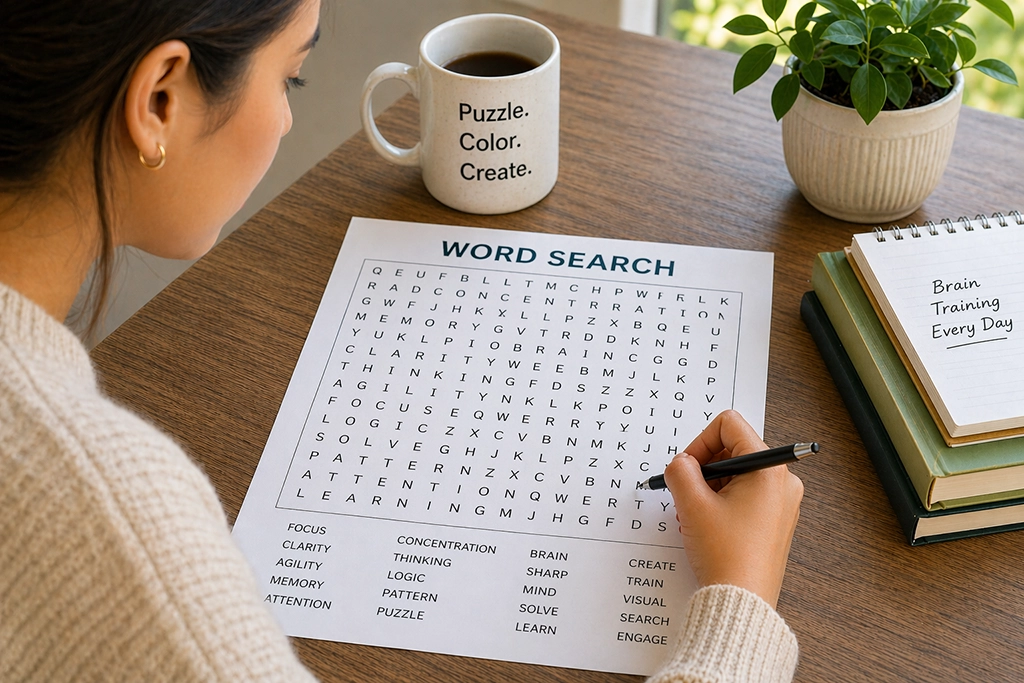
Both printable and digital word searches can support mental agility. The better choice depends on what helps you stay consistent.
Printable word search puzzles work well for people who want fewer screen distractions. Paper gives you a fixed page, a clear word list and a simple way to mark progress. Many people also find it easier to scan a printed grid because the full puzzle stays visible at once. There are no pop-ups, no tabs and no alerts pulling attention away.
Printables also make it easy to build a routine. You can keep a puzzle book on the table, in a bag or near your desk. That physical reminder helps some people do the puzzle more often. It is simple, and simple matters.
Digital word searches have different strengths. They are portable and easy to access. You can do one while waiting in line, during a break or while traveling. Apps often include timers, hints and difficulty settings, which can make it easier to adjust the challenge.
Still, digital formats can come with more distractions. If the same device holds your messages, email and social feeds, it is easier to lose focus. That does not make digital puzzles worse. It just means you may need more control over your environment.
Comfort matters too. Some people prefer the feel of pen or pencil. Others like tapping and swiping. Some prefer large printed pages. Others like zooming in on a tablet. Use the format that helps you solve with the most attention and the least friction.
A practical approach is to use both. Keep printables at home for longer, focused sessions. Use digital word searches when you need something quick and portable. The main goal is not to pick the perfect format. The goal is to keep doing the puzzle.
Who Should Try Word Search Puzzles for Mental Agility?
Word searches are a good fit for people who want a simple way to stay mentally engaged. You do not need puzzle experience. You do not need a lot of free time. You just need an interest in focused, structured activity.
They work well for adults who want a break from screens without doing nothing. They also work for people who like brain games but do not want something with a steep learning curve. A word search gives clear instructions and a clear result. That makes it easier to begin and easier to repeat.
Beginners often do well with word searches because the task feels familiar. Most people already know how to look for words in a grid. That means there is less friction at the start. You can begin with easy puzzles and raise the challenge over time.
Word searches also suit people who want calm mental activity. Some puzzles create pressure because they depend on trivia knowledge, math skill or complex logic steps. A word search keeps the demand focused on visual scanning, attention and persistence. For many people, that feels more manageable.
They are also useful for people building a puzzle habit. If you want to do more sudoku, crosswords or logic puzzles later, a word search can be an easy entry point. It helps you get used to sitting down, focusing and finishing a task.
That said, word searches are not for everyone. Some people want deeper logic or more variety. That is fine. The best brain game is the one you will actually keep doing.
If you want a low-barrier way to practice focus, pattern recognition and concentration, word searches make sense. They are simple, flexible and easy to fit into real life.
Word search for mental agility is a practical topic because the puzzle itself is practical. It asks you to slow down, focus, scan carefully and stay engaged. That combination can make word searches a useful part of a broader brain game routine. They are simple to start, easy to repeat and flexible enough for different ages and skill levels.
If you want a low pressure way to challenge your brain, word searches are a solid place to begin. Start with a few puzzles each week, increase the difficulty over time and make it part of your routine. Small habits matter and a good puzzle can be one of them.